


Page 8 - Chemical Protective Footwear
P. 8
  OTHER BOOT FEATURES
ANTISTATIC AND ESD FOOTWEAR
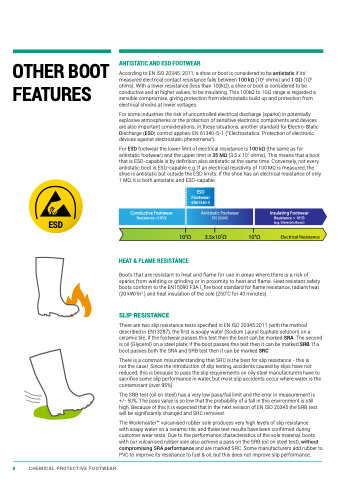
According to EN ISO 20345: 2011, a shoe or boot is considered to be antistatic if its’ measured electrical contact resistance falls between 100 kΩ (105 ohms) and 1 GΩ (109 ohms). With a lower resistance (less than 100kΩ), a shoe or boot is considered to be conductive and at higher values, to be insulating. This 100kΩ to 1GΩ range is regarded a sensible compromise, giving protection from electrostatic build up and protection from electrical shocks at lower voltages.
For some industries the risk of uncontrolled electrical discharge (sparks) in potentially explosive atmospheres or the protection of sensitive electronic components and devices are also important considerations. In these situations, another standard for Electro-Static Discharge (ESD) control applies: EN 61340-5-1 (“Electrostatics. Protection of electronic devices against electrostatic phenomena”).
For ESD footwear the lower limit of electrical resistance is 100 kΩ (the same as for antistatic footwear) and the upper limit is 35 MΩ (3.5 x 10⁷ ohms). This means that a boot that is ESD-capable is by definition also antistatic at the same time. Conversely, not every antistatic boot is ESD-capable e.g. If an electrical resistivity of 100 MΩ is measured, the shoe is antistatic but outside the ESD limits. If the shoe has an electrical resistance of only 1 MΩ, it is both antistatic and ESD-capable.
      ESD
    105Ω
HEAT & FLAME RESISTANCE
ESD Footwear EN61340-5
Antistatic Footwear EN 20345
3.5x10⁷Ω
Insulating Footwear Resistance > 109Ω (e.g. Dielectric Boots)
109Ω Electrical Resistance
 8 CHEMICAL PROTECTIVE FOOTWEAR
Conductive Footwear Resistance <105Ω
Boots that are resistant to heat and flame for use in areas where there is a risk of sparks from welding or grinding or in proximity to heat and flame. Heat resistant safety boots conform to the EN15090 F3A I3 fire boot standard for flame resistance, radiant heat (20 kW/m2 ) and heat insulation of the sole (250oC for 40 minutes).
SLIP RESISTANCE
There are two slip resistance tests specified in EN ISO 20345:2011 (with the method described in EN13287); the first is soapy water (Sodium Lauryl Suphate solution) on a ceramic tile. If the footwear passes this test then the boot can be marked SRA. The second is oil (Glycerol) on a steel plate, if the boot passes this test then it can be marked SRB. If a boot passes both the SRA and SRB test then it can be marked SRC.
There is a common misunderstanding that SRC is the best for slip resistance - this is
not the case! Since the introduction of slip testing, accidents caused by slips have not reduced; this is because to pass the slip requirements on oily steel manufacturers have to sacrifice some slip performance in water, but most slip accidents occur where water is the contaminant (over 95%).
The SRB test (oil on steel) has a very low pass/fail limit and the error in measurement is +/- 50%. The pass value is so low that the probability of a fall in this environment is still high. Because of this it is expected that in the next revision of EN ISO 20345 the SRB test will be significantly changed and SRC removed.
The WorkmasterTM vulcanised rubber sole produces very high levels of slip resistance
with soapy water on a ceramic tile, and these test results have been confirmed during customer wear tests. Due to the performance characteristics of the sole material, boots with our vulcanised rubber sole also achieve a pass on the SRB (oil on steel test), without compromising SRA performance and are marked SRC. Some manufacturers add rubber to PVC to improve its resistance to fuel & oil, but this does not improve slip performance.


