


Page 6 - Chemical Protective Footwear
P. 6
  CHEMICAL PENETRATION, PERMEATION AND DEGRADATION
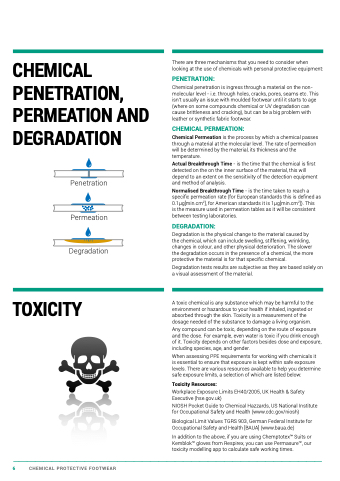
Penetration
Permeation
Degradation
TOXICITY
There are three mechanisms that you need to consider when looking at the use of chemicals with personal protective equipment:
PENETRATION:
Chemical penetration is ingress through a material on the non- molecular level - i.e. through holes, cracks, pores, seams etc. This isn’t usually an issue with moulded footwear until it starts to age (where on some compounds chemical or UV degradation can cause brittleness and cracking), but can be a big problem with leather or synthetic fabric footwear.
CHEMICAL PERMEATION:
Chemical Permeation is the process by which a chemical passes through a material at the molecular level. The rate of permeation will be determined by the material, its thickness and the temperature.
Actual Breakthrough Time - is the time that the chemical is first detected on the on the inner surface of the material, this will depend to an extent on the sensitivity of the detection equipment and method of analysis.
Normalised Breakthrough Time - is the time taken to reach a specific permeation rate (for European standards this is defined as 0.1μg[min.cm2], for American standards it is 1μg[min.cm2]). This
is the measure used in permeation tables as it will be consistent between testing laboratories.
DEGRADATION:
Degradation is the physical change to the material caused by the chemical, which can include swelling, stiffening, wrinkling, changes in colour, and other physical deterioration. The slower the degradation occurs in the presence of a chemical, the more protective the material is for that specific chemical.
Degradation tests results are subjective as they are based solely on a visual assessment of the material.
A toxic chemical is any substance which may be harmful to the environment or hazardous to your health if inhaled, ingested or absorbed through the skin. Toxicity is a measurement of the dosage needed of the substance to damage a living organism.
Any compound can be toxic, depending on the route of exposure and the dose. For example, even water is toxic if you drink enough of it. Toxicity depends on other factors besides dose and exposure, including species, age, and gender.
When assessing PPE requirements for working with chemicals it is essential to ensure that exposure is kept within safe exposure levels. There are various resources available to help you determine safe exposure limits, a selection of which are listed below:
Toxicity Resources:
Workplace Exposure Limits EH40/2005, UK Health & Safety Executive (hse.gov.uk)
NIOSH Pocket Guide to Chemical Hazzards, US National Institute for Occupational Safety and Health (www.cdc.gov/niosh)
Biological Limit Values TGRS 903, German Federal Institute for Occupational Safety and Health [BAUA] (www.baua.de)
In addition to the above, if you are using ChemptotexTM Suits or KemblokTM gloves from Respirex, you can use PermasureTM, our toxicity modelling app to calculate safe working times.
                                                        6 CHEMICAL PROTECTIVE FOOTWEAR


