


Page 9 - Chemical Protective Footwear
P. 9
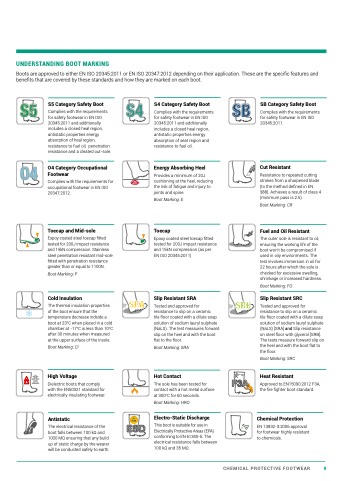
 UNDERSTANDING BOOT MARKING
Boots are approved to either EN ISO 20345:2011 or EN ISO 20347:2012 depending on their application. These are the specific features and benefits that are covered by these standards and how they are marked on each boot.
         S5 S5CategorySafetyBoot Complies with the requirements
S4 S4CategorySafetyBoot Complies with the requirements
for safety footwear in EN ISO 20345:2011 and additionally includes a closed heal region, antistatic properties energy absorption of seat region and resistance to fuel oil.
Energy Absorbing Heel
Provides a minimum of 20J cushioning at the heel, reducing the risk of fatigue and injury to joints and spine.
Boot Marking: E
Toecap
Epoxy coated steel toecap fitted tested for 200J impact resistance and 15kN compression (as per EN ISO 20345:2011)
Slip Resistant SRA
Tested and approved for resistance to slip on a ceramic
tile floor coated with a dilute soap solution of sodium lauryl sulphate (NaLS). The test measures forward slip on the heel and with the boot flat to the floor.
Boot Marking: SRA
Hot Contact
The sole has been tested for contact with a hot metal surface at 300oC for 60 seconds.
Boot Marking: HRO
Electro-Static Discharge
This boot is suitable for use in Electrically Protective Areas (EPA) conforming to EN 61340-5. The electrical resistance falls between 100 kΩ and 35 MΩ.
SB SBCategorySafetyBoot Complies with the requirements
for safety footwear in EN ISO 20345:2011.
Cut Resistant
Resistance to repeated cutting strokes from a sharpened blade (to the method defined in EN 388). Achieves a result of class 4 (minimum pass is 2.5).
Boot Marking: CR
Fuel and Oil Resistant
The outer sole is resistant to oil, ensuring the working life of the boot won’t be compromised if used in oily environments. The test involves immersion in oil for 22 hours after which the sole is checked for excessive swelling, shrinkage or increased hardness.
Boot Marking: FO
SRC Slip Resistant SRC Tested and approved for
resistance to slip on a ceramic
tile floor coated with a dilute soap solution of sodium lauryl sulphate (NaLS) [SRA] and Slip resistance on steel floor with glycerol [SRB]. The tests measure forward slip on the heel and with the boot flat to the floor.
Boot Marking: SRC
F3A Heat Resistant
Approved to EN15090:2012 F3A,
the fire fighter boot standard.
Chemical Protection
EN 13832-3:2006 approval for footwear highly resistant to chemicals.
   for safety footwear in EN ISO 20345:2011 and additionally includes a closed heal region, antistatic properties energy absorption of heal region, resistance to fuel oil, penetration resistance and a cleated out-sole.
O4
         O4 Category Occupational
Footwear
Complies with the requirements for occupational footwear in EN ISO 20347:2012.
Toecap and Mid-sole
Expoy coated steel toecap fitted tested for 200J impact resistance and 15kN compression. Stainless steel penetration resistant mid-sole fitted with penetration resistance greater than or equal to 1100N.
Boot Marking: P
Cold Insulation
The thermal insulation properties of the boot ensure that the temperature decrease indside a boot at 23oC when placed in a cold chamber at -17oC is less than 10oC after 30 minutes when measured at the upper surface of the insole.
Boot Marking: CI
High Voltage
Dielectric boots that comply with the EN50321 standard for electrically insulating footwear.
Antistatic
The electrical resistance of the boot falls between 100 kΩ and 1000 MΩ ensuring that any build up of static charge by the wearer will be conducted safely to earth.
SRA
                                                    CHEMICAL PROTECTIVE FOOTWEAR 9


