


Page 4 - CBRN Overboots
P. 4
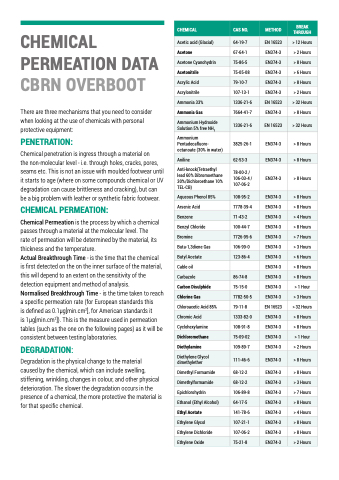
    CHEMICAL CAS NO. METHOD
BREAK THROUGH
 Acetic acid (Glacial) 64-19-7 EN 16523 > 12 Hours
 Acetone 67-64-1 EN374-3 > 2 Hours
 Acetone Cyanohydrin 75-86-5 EN374-3 > 8 Hours
 Acetonitrile 75-05-08 EN374-3 > 6 Hours
 Acrylic Acid 79-10-7 EN374-3 > 8 Hours
 Acrylonitrile 107-13-1 EN374-3 > 2 Hours
 Ammonia 33% 1336-21-6 EN 16523 > 32 Hours
 Ammonia Gas 7664-41-7 EN374-3 > 8 Hours
 Ammonium Hydroxide Solution 5% free NH3
1336-21-6 EN 16523 > 32 Hours
 Ammonium
Pentadecafluoro- 3825-26-1 EN374-3 > 8 Hours octanoate (30% in water)
 Aniline 62-53-3 EN374-3 > 8 Hours
      Anti-knock(Tetraethyl lead 60% Dibromoethane 30%/Dichloroethane 10% TEL-CB)
78-00-2 / 106-03-4 / 107-06-2
EN374-3 > 8 Hours
 Aqueous Phenol 85% 108-95-2 EN374-3 > 8 Hours
 Arsenic Acid 7778-39-4 EN374-3 > 8 Hours
 Benzene 71-43-2 EN374-3 > 4 Hours
 Benzyl Chloride 100-44-7 EN374-3 > 8 Hours
 Bromine 7726-95-6 EN374-3 > 7 Hours
 Buta-1,3diene Gas 106-99-0 EN374-3 > 3 Hours
 Butyl Acetate 123-86-4 EN374-3 > 6 Hours
 Cable oil EN374-3 > 8 Hours
 Carbazole 86-74-8 EN374-3 > 8 Hours
 Carbon Disulphide 75-15-0 EN374-3 > 1 Hour
 Chlorine Gas 7782-50-5 EN374-3 > 3 Hours
 Chloroacetic Acid 85% 79-11-8 EN 16523 > 32 Hours
 Chromic Acid 1333-82-0 EN374-3 > 8 Hours
 Cyclohexylamine 108-91-8 EN374-3 > 8 Hours
 Dichloromethane 75-09-02 EN374-3 > 1 Hour
 Diethylamine 109-89-7 EN374-3 > 2 Hours
 Diethylene Glycol dimethylether
111-46-6 EN374-3 > 8 Hours
 Dimethyl Formamide 68-12-2 EN374-3 > 8 Hours
 Dimethylformamide 68-12-2 EN374-3 > 3 Hours
 Epichlorohydrin 106-89-8 EN374-3 > 7 Hours
 Ethanol (Ethyl Alcohol) 64-17-5 EN374-3 > 8 Hours
 Ethyl Acetate 141-78-6 EN374-3 > 4 Hours
 Ethylene Glycol 107-21-1 EN374-3 > 8 Hours
 Ethylene Dichloride 107-06-2 EN374-3 > 8 Hours
 Ethylene Oxide 75-21-8 EN374-3 > 2 Hours
    CHEMICAL PERMEATION DATA CBRN OVERBOOT
There are three mechanisms that you need to consider when looking at the use of chemicals with personal protective equipment:
PENETRATION:
Chemical penetration is ingress through a material on
the non-molecular level - i.e. through holes, cracks, pores, seams etc. This is not an issue with moulded footwear until it starts to age (where on some compounds chemical or UV degradation can cause brittleness and cracking), but can be a big problem with leather or synthetic fabric footwear.
CHEMICAL PERMEATION:
Chemical Permeation is the process by which a chemical passes through a material at the molecular level. The rate of permeation will be determined by the material, its thickness and the temperature.
Actual Breakthrough Time - is the time that the chemical is first detected on the on the inner surface of the material, this will depend to an extent on the sensitivity of the detection equipment and method of analysis.
Normalised Breakthrough Time - is the time taken to reach a specific permeation rate (for European standards this
is defined as 0.1μg[min.cm2], for American standards it
is 1μg[min.cm2]). This is the measure used in permeation tables (such as the one on the following pages) as it will be consistent between testing laboratories.
DEGRADATION:
Degradation is the physical change to the material
caused by the chemical, which can include swelling, stiffening, wrinkling, changes in colour, and other physical deterioration. The slower the degradation occurs in the presence of a chemical, the more protective the material is for that specific chemical.


