


Page 2 - Chemical Protective Footwear
P. 2
  WHY DO YOU NEED SPECIALIST CHEMICAL FOOTWEAR?
Harmful chemicals pose a wide range of health hazards (such as irritation, sensitization, and carcinogenicity) and physical hazards (such as flammability, corrosion, and explosiveness).
Employers with hazardous chemicals in their workplaces must ensure that they are labelled correctly, with safety data sheets easily accessible and that employees are trained how to handle them appropriately. Training for employees must also include information on the hazards of the chemicals in their work area and the measures to be used to protect themselves.
The ideal way to protect yourself from any chemical is to keep well away from it; any other mode of protection is ultimately a compromise. For this reason, if elimination or substitution of the chemical are not possible, engineering and work practice controls are the preferred means to reduce employee exposure to toxic chemicals, where feasible. Personal Protective Equipment (PPE) is the least desirable measure but is highly effective when used correctly.
Chemical protective footwear forms an important part of an overall PPE solution. Depending on the nature of the chemical and the exposure some or all of the following may be required to provide effective protection.
• Chemical protective clothing
This could be a single piece suit, or separate jacket & trousers and may incorporate a hood or even completely encapsulate the wearer if their breathing air is supplied by an air-line or breathing apparatus.
• Respiratory protection
This can range from a simple facemask respirator, to powered respirators or supplied air from breathing apparatus or air-line. If air is being filtered it is vital to check the efficacy of the filter against the chemicals to which the wearer is exposed and that there is sufficient oxygen in the atmosphere.
• Eye protection
This can be provided by goggles, a full facemask or from a suit with an integral visor.
• Chemical protective gloves
These need to provide sufficient protection from the chemical to which the wearer may be exposed, but also provide sufficient mechanical protection for the challenges of the job and working environment
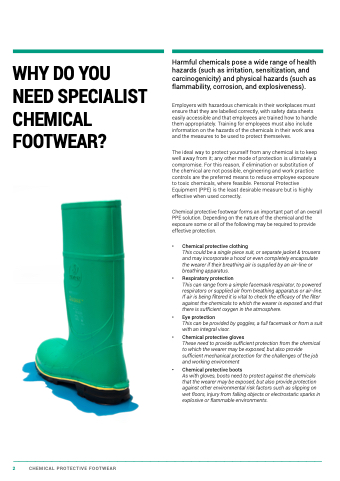
• Chemical protective boots
As with gloves, boots need to protect against the chemicals that the wearer may be exposed, but also provide protection against other environmental risk factors such as slipping on wet floors, injury from falling objects or electrostatic sparks in explosive or flammable environments.
    2 CHEMICAL PROTECTIVE FOOTWEAR


